
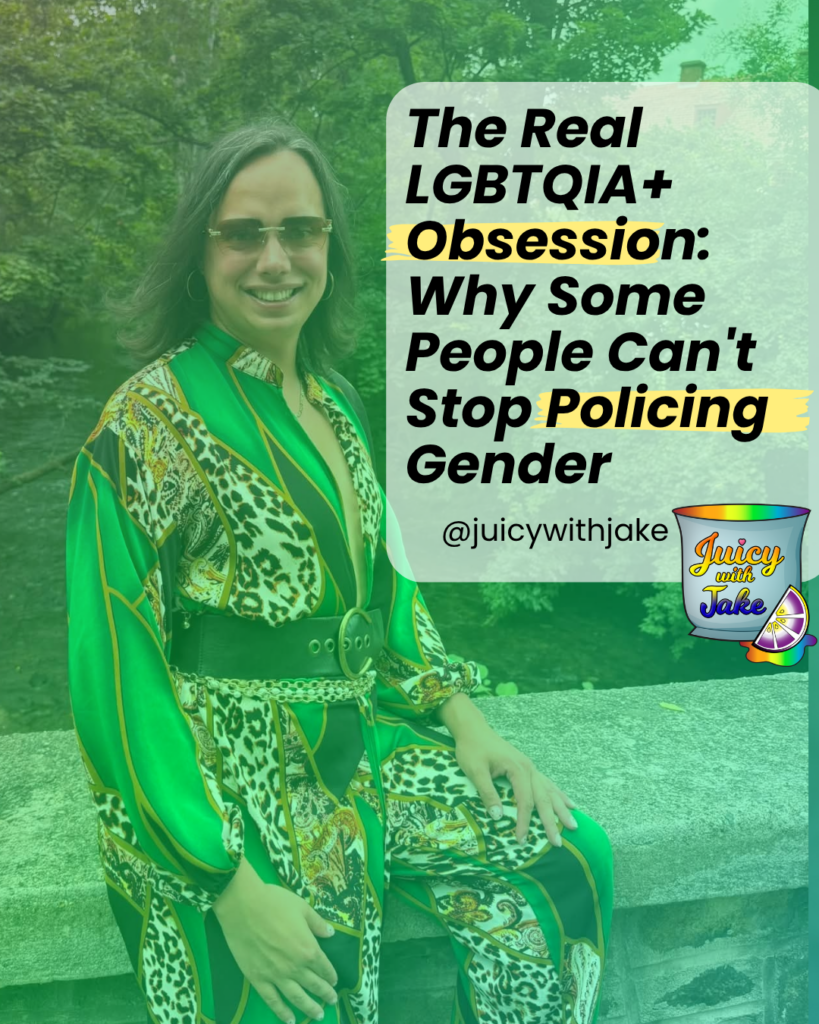
The Real LGBTQIA+ Obsession: Why Some People Can’t Stop Policing Gender
Before anyone tells me how trans and nonbinary people express themselves, I want to point out the actual encounters. This isn’t about how we behave. It’s about how many everyday, ordinary behaviors get called out as “LGBTQIA+ behavior” simply because of who’s doing them. I have recently been noticing more people in my everyday life, my circles, and online who are obsessed with whether I am trans, a girl, or just feminine. To be clear, there isn’t anything I am doing other than existing. It’s an acknowledgment of the effect of existing authentically. So who cares more about trans and LGBTQ2SIA+ people? Honestly, the real question is who is obsessed. The answer is the haters.
The Perception
There’s a common belief that LGBTQIA+ people care too much about themselves, which is what would be considered too much. We have Pride, awareness days, and we’re always telling people who we are by coming out. If you’re not part of the community, that might genuinely look like a lot. But here’s the piece that’s easy to miss from the outside: those days and that visibility exist because for most of history, we weren’t allowed to exist out loud at all. Pride started as a protest, not a party. Coming out or inviting people in is necessary because the world defaults to assuming everyone is straight and cisgender (heteronormativity and cisnormativity) until told otherwise, so silence isn’t neutral; it’s erasure. Awareness days exist because most people still don’t know we’re in the room. None of that is the same thing as obsession. It’s correction.
Think about what “correction” actually means here. For most of my life, and for generations before mine, being visibly queer wasn’t just uncomfortable, it was dangerous. People lost jobs, families, housing, and sometimes their lives simply for being known. So the community didn’t build Pride and awareness days out of vanity. We built them because the alternative was silence, and silence protected no one. It only protected other people’s comfort. A day of visibility once a year is a small win and correction against decades, sometimes centuries, of being told to disappear.
And it’s not constant the way people assume. Pride happens once a year, in June, to acknowledge a specific day of fighting back against police brutality. Awareness days are scattered a handful of times across the calendar: National Coming Out Day, Trans Day of Visibility, a handful of others, where for one day people actively acknowledge their bias and then the day passes. Compare that rhythm to what I and many others actually live: comments, stares, and confrontations that show up on a random Tuesday, at the grocery store, in my inbox, in the comment section under a video about something that has nothing to do with my identity at all. I remember I received an award of excellence in humanities with 2 others who happen to be women, and the majority of the comments had to do with how I looked and what they perceived, not the fact that I received this award for my work. One of these is scheduled, historical, and occasional and has meaning. The other is constant, unscheduled, and provoked by nothing more than my existing in public. If we’re being honest about who’s preoccupied, the math adds up to who is obsessed with us more, which is the bigots. However, this blog is not about this history of LGBTQ2SIA+ people. I want to name the other side of this coin: the haters and the ignorant people who feel enraged, bothered, and entitled to speak on hate.
What It Actually Looks Like
As a visible fem nonbinary person, my queerness is always highlighted, seen, and loud. Not because I do anything special, but because I exist in a body and a presentation people have opinions about before I’ve said a word. As a content creator and speaker, I’m out in public space constantly, talking about my day, my thoughts, general things that have nothing to do with my identity. And still, the comments, the messages, the words people send me are about how they perceive me. “You’ll never be a woman.” “Stop pretending.” “I just see a guy.” These aren’t responses to anything I said or did. They’re just people announcing their ignorance, hate, and bigotry out loud, uninvited, as if my body and identity are a debate they’re entitled to weigh in on.
If you’re part of this community, you already know this feeling: getting stared down, misgendered, or lectured by a stranger who knows nothing about you except what they’ve decided to see. My personal favorite is the bible quotes that, if you were to use back at them all of a sudden, wouldn’t apply. If you’re not part of this community, picture it like this: imagine walking through your day and having strangers periodically stop to inform you that your identity is fake. You are standing there with your friends, and two people walk by to stare at you and make nasty looks and comments. You are walking into a store, and teens are publicly mocking you for how you appear. Not because of anything you did, but because you were visible, you are seen.
Here’s where the real obsession shows up. I was simply shopping in a store and posted a video. A woman from the same area saw it and commented, “ I need to move out of town,” implying that people like me don’t belong here. Never mind the fact that I’ve lived here for years. Personally, I think a mindset like hers will benefit more from leaving if it means being exposed to different people and lessening the ignorance that often comes from a lack of critical thinking. The way she reacted, you’d think I had just appeared out of nowhere. As if people like me have never existed in this community before. But we have. We always have. That’s not awareness. It’s someone suddenly confronting a fear or discomfort they’ve carried for years and deciding that my existence is the problem, rather than questioning the beliefs they’ve been holding onto.
Think about what that actually requires. That’s a long time to be somewhere. I’ve been at the grocery store, the gas station, the post office, the same handful of places everyone in a small town circles through, again and again, for years. She didn’t miss me. She wasn’t somewhere else. I was there the whole time, living an unremarkable life in a town small enough that most people know most people. So what changed wasn’t my presence. What changed was her willingness to see it, and the moment she did, she needed somewhere to put the discomfort. Not inward, where it actually lived. Outward, onto me, in my comments, in front of strangers, as if saying it out loud would make the feeling go away.
That’s the part people miss when they call us the obsessed ones. She didn’t research me. She didn’t ask a single question about who I am or how long I’ve been her neighbor. She looked at me for a few seconds and decided she already knew everything she needed to know. That’s not vigilance. That’s not protecting anything. That’s a person who has spent years being uncomfortable with the idea of people like me, finally handed a face to attach it to, and choosing confrontation over the much smaller, much braver option: sitting with discomfort and asking herself where it actually came from.
The Stereotypes Don’t Hold Up
This is where the stereotypes begin to fall apart. The arguments people use don’t even stay consistent with each other. Here are some of the most common narratives I encounter.
I’m told I’m too loud, too visible, too “in your face” about my identity. Yet I’m also told that the years I’ve quietly lived in the same town somehow don’t count, because the moment someone decides to notice me, they act as if I suddenly appeared out of nowhere. Which is it? Am I impossible to ignore, or was I invisible until it became convenient to see me?
Then there’s the predator narrative. This is rooted in prejudice and a lack of understanding. It assumes that if someone’s identity makes you uncomfortable, they must somehow be dangerous to others. That’s why accusations of “grooming” or harming children are so often directed at LGBTQ2SIA+ people based solely on how they look or exist. There is no evidence that being transgender or nonbinary makes someone more likely to harm others. In fact, when researchers examine who commits the majority of sexual offenses, they overwhelmingly find that offenders are most often cisgender men, according to the U.S. Department of Justice’s Bureau of Justice Statistics National Crime Victimization Survey. The stereotype says far more about people’s fears than it does about reality.
There’s also the “confused kids” narrative. In reality, children see me all the time. Most of them compliment my colorful outfits or simply ask, “Are you a boy or a girl?” I answer honestly: “I’m nonbinary.” Almost every time, they respond with “Okay,” and move on with their day. Children usually aren’t the ones struggling with difference. Adults often teach them to.
Then there’s the claim that I’m “just doing it for attention” or “following a trend.” Those arguments contradict each other, just like many of the others. People are not trends. Gender is a lifelong journey for everyone. From birth to death, every person develops an understanding of who they are. The difference is that some people are given the freedom to explore and name that journey, while others are ridiculed the moment their exploration falls outside society’s expectations.
What ties all of these narratives together is that the people who are making these claims don’t have to be consistent. Nobody notices the contradictions because consistency was never the goal. The goal has always been to find a reason to be uncomfortable with people like me existing.
Look at each of these narratives on its own, and they start to fall apart. None of them were ever built to withstand scrutiny. They exist to be swapped in and out depending on what is most convenient in the moment, whatever allows someone to avoid asking why my existence makes them uncomfortable in the first place. A real observation becomes stronger the more closely you examine it, but a stereotype only survives if no one questions it. The moment you hold two of these narratives side by side, “predator” and “confusing children,” “too visible” and “invisible until noticed,” they contradict each other. What’s left isn’t evidence about me. It’s evidence that some people are searching for any reason, no matter how inconsistent, to justify their discomfort with LGBTQ2SIA+ existence instead of examining where that discomfort actually comes from.
Before You Tell Me How Trans and Nonbinary People “Behave”
One of the most revealing things I’ve noticed is how often ordinary human behavior gets relabeled as “LGBTQ2SIA+ behavior” the moment people believe someone is queer or trans. The way I stand, walk, laugh, sit on a couch, talk with my hands, hug a friend, dress, or spend time with the people I care about suddenly becomes something to analyze. People comment on my laughter as though laughter has a gender. They question the way I hug someone hello, as though affection is only acceptable if it fits a narrow idea of masculinity or femininity. The way I sit or gesture is treated as a clue, as if my body is constantly revealing some hidden truth about who I am. In reality, none of these behaviors belong to any sexual orientation or gender identity. They are simply human behaviors.
Society has long created stereotypes about what a “sissy boy,” a feminine man, a masculine woman, or a gender-nonconforming person is supposed to look and act like. These ideas have existed for generations and have shaped how people react to anyone who falls outside traditional expectations of masculinity and femininity. Once someone believes you fit one of these stereotypes, ordinary human behaviors are no longer seen as ordinary. They become “evidence” that confirms what the observer already believes. A straight man can laugh loudly, hug his friends, wear bright colors, speak with his hands, or enjoy fashion without those actions being interpreted as statements about his identity. Yet when a trans or nonbinary person does the same things, those ordinary behaviors are treated as proof that something is different.
This isn’t objective observation. It’s confirmation bias. People begin with a conclusion about who they believe I am, and then selectively notice the behaviors that seem to support that conclusion while ignoring all the time those same behaviors appear in everyone else. The behavior never changed. The standard used to judge it did. That’s why I push back whenever someone tells me how trans or nonbinary people “behave.” Often, they aren’t describing behaviors that belong to LGBTQIA+ people at all. They’re describing ordinary human behaviors that they’ve decided stand out only because of who they believe is doing them. The real difference isn’t in how I exist. It’s in how my existence is interpreted.
Gender Policing and Heteronormativity
There’s a term for this reflex: gender policing. Researchers, building on sociologists Candace West and Don Zimmerman’s 1987 concept of “doing gender, use the term to describe the ways people enforce heteronormative expectations about masculinity and femininity on anyone who falls outside those norms. Whether intentional or not, gender policing reinforces the boundary between what society considers “normal” and what it labels as different or unacceptable. A 2021 study by researcher D. Yarbrough, published in the journal Punishment & Society, on transgender women and housing found that this policing doesn’t only happen between individuals. It also operates structurally, shaping who is believed, who is welcomed, and who is denied access to safe housing.
Judith Butler’s theory of gender performativity, introduced in Gender Trouble (1990), helps explain why this happens. Butler argues that gender is not simply something we are born with; it is something we continually perform through repeated behaviors that society comes to recognize as “natural.” Because these expectations are socially maintained rather than fixed, people often police others whose gender expression falls outside those expectations. In doing so, they reinforce not only social norms but also their own understanding of what gender is supposed to look like. In other words, it was never about me. It was about someone needing me to fit neatly into a category so their worldview could continue to make sense.
There’s also a term for what happened when people abruptly need to confront my gender: gender panic. Sociologists Kristen Schilt and Laurel Westbrook, in their 2009 study “Doing Gender, Determining Gender,” published in the journal Gender & Society, use this concept to describe the fear or anxiety that arises when rigid beliefs about the male and female binary are challenged. Their research suggests that this panic is rarely a response to an actual threat. Instead, it is a reaction to an imagined one. Let’s use an example of when a woman in a store saw me shopping for clothes and made comments about how I shouldn’t belong in this section. The woman in the store wasn’t responding to anything I had done, as she could mind her own business and I mine. She was responding to beliefs and fears she already carried long before she ever saw me. Her excuses fall back on the stereotyping and reasoning that are made from this gender panic she feels.
And none of this is rare or isolated. A University of Georgia study (2020), led by Nat Truszczynski along with co-authors Anneliese A. Singh and Nathan Hansen and published in the Journal of Homosexuality, asked transgender and nonbinary participants to record their daily experiences over the course of 30 days. On average, participants experienced at least one form of discrimination every day, with most incidents taking the form of subtle slights and microaggressions rather than overt acts of hostility. The research confirms what many transgender and nonbinary people already know through lived experience: these interactions are not exceptional. They are routine. The constant scrutiny, assumptions, and policing are part of daily life, and they are not created by transgender and nonbinary people. They are imposed on us by a society that continues to monitor and enforce narrow expectations about gender.
So, Who Is More Obsessed?
So, let’s return to the original question: who is actually more obsessed with LGBTQIA+ people? This isn’t about perception. It’s about patterns of behavior. If any of these experiences sound familiar, you’re not imagining them, and you’re certainly not alone. If this perspective is new to you, consider the difference. A Pride flag in June is intentional. It’s scheduled, historical, and a celebration of a community that has fought for the right to exist openly. But compare that to what happens in everyday life. A stranger comments that I need to leave town. Someone in a store tells me how I should look or act. A man mocks me as I walk by. Someone tries to intimidate me in public. A barista laughs at my appearance. None of those moments were started by me. I wasn’t talking about my identity. I wasn’t asking for attention. I was buying groceries, getting coffee, walking down the street, spending time with friends, or simply existing like anyone else.
The pattern is worth paying attention to. The person bringing up my gender or identity is almost never me. It’s the stranger who feels compelled to comment, stare, laugh, confront, or judge. For me, these are ordinary moments of everyday life. For them, my existence becomes something they feel the need to respond to.
That response doesn’t come from nowhere. Reflexes are learned. They are shaped by years of stereotypes, misinformation, and cultural narratives about people like me. Most of the people who judge me have never met me. They don’t know my story, my values, or my life. What they know is a story they were taught about people “like me,” and they project that story onto a complete stranger. In that moment, I stop being a person buying groceries and become a symbol of everything they’ve been taught to fear, question, or reject.
That’s the real obsession. It isn’t the one month each year that LGBTQ2SIA+ people celebrate our history, our resilience, and our survival. It’s the daily impulse to monitor, comment on, judge, or confront people who are simply living their lives. One side is trying to exist. The other keeps insisting that existence requires an explanation.